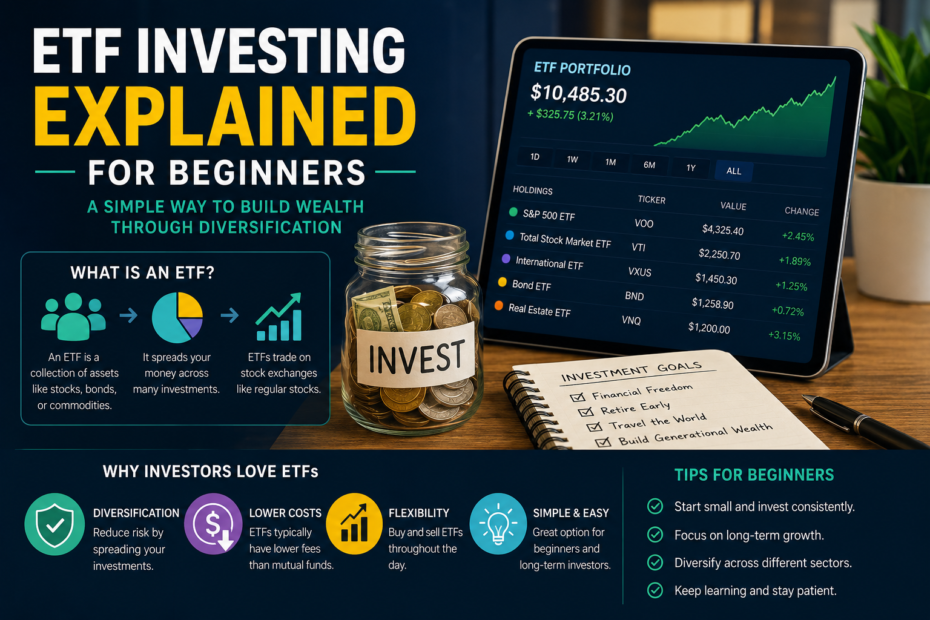
Investing has become one of the most discussed financial topics in recent years. Millions of people are searching for safer and smarter ways to grow their money while protecting themselves from inflation and economic uncertainty. Among all modern investment options, Exchange-Traded Funds, commonly known as ETFs, have become one of the most popular choices for beginner investors.
Many Americans are now moving away from traditional savings accounts and looking for investment strategies that offer long-term growth potential. ETFs have gained attention because they combine simplicity, affordability, and diversification in a way that makes investing easier for ordinary people.
For beginners, the stock market can feel confusing and risky. Choosing individual stocks requires research, experience, and emotional control. ETFs simplify this process by allowing investors to buy multiple assets in a single investment instead of relying on the success of only one company.
This investment strategy has become especially attractive to young investors who want to build wealth gradually without taking excessive risks. Understanding how ETFs work can help beginners make smarter financial decisions and avoid common mistakes that often affect new investors.
What Is an ETF and How Does It Work?
An ETF, or Exchange-Traded Fund, is a type of investment fund that holds a collection of assets such as stocks, bonds, commodities, or other securities. Instead of purchasing shares from only one company, investors who buy an ETF gain exposure to many investments at the same time.
ETFs trade on stock exchanges just like regular stocks. This means investors can buy or sell ETF shares during market hours using investment platforms or brokerage accounts.
One of the biggest advantages of ETFs is diversification. Rather than depending entirely on one business or industry, ETFs spread investments across multiple companies or sectors. This helps reduce overall risk because poor performance from one asset may be balanced by stronger performance from others.
For example, some ETFs follow major stock market indexes like the S&P 500. These funds allow investors to own small portions of hundreds of major companies through a single investment.
ETFs have become extremely popular because they are easy to understand and often have lower fees compared to traditional actively managed investment funds.
Why ETFs Are Popular Among Beginner Investors
Many beginners prefer ETFs because they simplify investing and reduce some of the stress associated with stock market decisions.
Diversification Reduces Risk
One of the main reasons ETFs attract beginner investors is diversification. Investing in individual stocks can be risky because one company’s poor performance may significantly impact a portfolio.
ETFs help reduce this risk by spreading investments across many assets.
Lower Investment Costs
Traditional investment funds sometimes charge high management fees. ETFs are often known for lower expense ratios, making them more affordable for long-term investors.
Lower costs can make a significant difference over many years because investors keep more of their returns.
Easy to Buy and Sell
ETFs trade like stocks, allowing investors to buy or sell shares quickly during normal market hours. This flexibility makes them convenient for both beginners and experienced investors.
Beginner-Friendly Strategy
Many financial experts recommend ETFs because they provide exposure to broad markets without requiring extensive research into individual companies.
This simplicity makes ETFs attractive for people who are just starting their investment journey.
Different Types of ETFs Investors Should Know
Not all ETFs are the same. Different types of ETFs focus on different investment goals, industries, and risk levels.
Stock ETFs
Stock ETFs invest primarily in company shares and are among the most common ETF categories. Some follow large market indexes, while others focus on specific industries such as technology, healthcare, or energy.
Bond ETFs
Bond ETFs invest in government or corporate bonds. These are generally considered more conservative investments compared to stock ETFs.
Many investors use bond ETFs to reduce portfolio volatility.
Sector ETFs
Sector ETFs focus on specific industries. For example, technology ETFs invest mainly in technology companies, while healthcare ETFs focus on medical and pharmaceutical businesses.
These ETFs allow investors to target industries they believe may perform well in the future.
International ETFs
International ETFs provide exposure to companies outside the United States. This helps investors diversify globally rather than relying entirely on one country’s economy.
Dividend ETFs
Dividend ETFs focus on companies that regularly pay dividends to shareholders. These funds can appeal to investors seeking passive income opportunities.
Understanding the differences between ETF categories helps investors choose investments that align with their financial goals and risk tolerance.
Why Young Investors Prefer ETFs Over Savings Accounts
Younger generations are increasingly choosing ETFs instead of relying only on traditional savings accounts. Several financial trends explain this shift.
Inflation Reduces Purchasing Power
Savings accounts often offer low interest rates that may not keep up with inflation. Over time, this can reduce the real value of saved money.
Many young investors view ETFs as a better long-term solution for growing wealth.
Long-Term Growth Potential
Historically, diversified stock market investments have provided stronger long-term returns compared to traditional savings accounts.
Although markets fluctuate in the short term, long-term investing has historically rewarded patient investors.
Technology Made Investing Easier
Modern investment apps and commission-free trading platforms have made ETFs extremely accessible. Many investors can now start with small amounts of money.
Financial Independence Goals
Younger investors are increasingly focused on financial independence and early retirement strategies. ETFs fit well into these goals because they support long-term wealth accumulation.
This generation is generally more open to learning about investing and using digital financial tools.
Common ETF Investing Mistakes Beginners Should Avoid
While ETFs are considered beginner-friendly investments, mistakes can still happen.
Investing Without Understanding Risk
Some beginners assume ETFs are completely risk-free. While diversification reduces certain risks, market fluctuations still affect ETF performance.
Investors should understand that all investments involve some level of uncertainty.
Chasing Market Trends
Many investors buy ETFs simply because they are popular or trending online. Emotional investing decisions can lead to poor long-term results.
Research and clear investment goals are important.
Lack of Diversification
Although ETFs are diversified by nature, concentrating only on one industry or market can still create risk.
Balanced portfolios often include multiple asset types.
Panic Selling During Market Declines
Market downturns are normal. Some beginners panic during short-term losses and sell investments too early.
Long-term investors usually focus on staying consistent rather than reacting emotionally to market volatility.
Ignoring Investment Fees
Even though ETFs generally have lower fees, expense ratios still matter. High fees can slowly reduce investment returns over time.
Comparing ETF costs is an important part of building an efficient portfolio.
Building a Long-Term ETF Investment Strategy
Successful investing usually depends more on consistency than perfect timing. ETFs are often most effective when used as part of a long-term strategy.
Many experienced investors contribute regularly regardless of market conditions. This approach, commonly called dollar-cost averaging, helps reduce the emotional impact of market volatility.
Long-term investing also benefits from compound growth. Reinvesting earnings and remaining invested for many years can significantly increase wealth over time.
Financial goals should guide investment decisions. Some people invest for retirement, while others focus on creating passive income, building wealth, or protecting against inflation.
Risk tolerance also matters. Younger investors may accept higher volatility for greater growth potential, while conservative investors may prefer more balanced portfolios.
Education remains one of the most valuable tools for any investor. Markets evolve constantly, and learning helps investors make smarter financial decisions over time.
Most importantly, successful investors understand that wealth building is usually a gradual process rather than an overnight achievement.
Conclusion
ETFs have transformed the investing world by making diversified investing accessible, affordable, and beginner-friendly. Millions of investors now use ETFs to build long-term wealth without needing advanced financial knowledge.
For beginners, ETFs provide a practical way to enter the stock market while reducing some of the risks associated with individual stock investing. Their flexibility, lower costs, and diversification make them one of the most popular investment tools today.
As inflation and economic uncertainty continue influencing financial decisions, more people are turning to ETFs as part of their long-term wealth-building strategies.
Starting early, investing consistently, and staying focused on long-term goals can help investors create stronger financial futures over time.
The most important step is often simply beginning the journey.
FAQs
What does ETF stand for?
ETF stands for Exchange-Traded Fund, which is a type of investment fund traded on stock exchanges like regular stocks.
Are ETFs safe for beginners?
ETFs are generally considered beginner-friendly because they provide diversification, although all investments still involve some level of risk.
Can I start investing in ETFs with little money?
Yes. Many platforms allow investors to buy ETFs with relatively small amounts of money.
Do ETFs pay dividends?
Some ETFs distribute dividends depending on the investments they hold.
Are ETFs better than savings accounts?
ETFs may offer higher long-term growth potential, but they also involve market risk, unlike traditional savings accounts.
How long should I hold ETFs?
Many investors use ETFs as long-term investments and hold them for years or even decades depending on their financial goals.